Tokyo to Kyoto in a day is a bold plan, but this tour makes it workable by pairing the bullet train with a private, nationally licensed guide. You’ll see Kinkaku-ji, Nishiki Market, and Fushimi Inari Shrine without having to manage Japan’s rail system and city buses alone.
In This Article
- Key points to know before booking
- Why this Kyoto day trip works from Tokyo
- Hotel pickup and the first rail connection
- The bullet train ride to Kyoto
- Kinkaku-ji and the Golden Pavilion
- Nishiki Market, Kyoto’s food corridor
- Fushimi Inari’s red torii gates
- Returning through Kyoto Station
- What the $915 price really buys
- Who should choose this day trip
- Booking details worth checking
- Should you book this Kyoto day trip?
- FAQ
- Where does the tour begin?
- How long is the experience?
- How long is the bullet train ride?
- What sights are included in Kyoto?
- Is the tour private?
- Which guide languages are available?
- Are bullet train tickets included?
- Is lunch included?
- Can dietary requirements be accommodated?
- Can the itinerary be changed?
- What happens if I need a taxi?
- What is the cancellation policy?
I like the hotel pickup and station help, especially after guides such as Yutaka and Kishy have guided visitors through the busy Tokyo rail network. I also like the freedom to request other Kyoto sights, though the published route already fills most of a long day.
The main drawback is simple: 12 hours is a lot of time on the move, including roughly five hours on trains. At $915 per person, this makes the most sense for a private group that values ease, a guide, and a Kyoto taste test more than a slow, extended stay.
Key points to know before booking
- Tokyo to Kyoto by bullet train: The round trip takes about five hours, but it gives you a full day in Kyoto without changing hotels.
- Three very different Kyoto stops: Kinkaku-ji offers polished temple scenery, Nishiki Market brings food and shopping, and Fushimi Inari provides its famous red torii gates.
- Private guiding: Only your group participates, with English, Spanish, or French guidance available.
- Station support matters: Guides such as Kishy and Yutaka have helped visitors find their way through Tokyo Station or Shinagawa Station and onto the correct train.
- Custom plans are possible: You can ask for other Kyoto sights, though every added stop means less time elsewhere.
- Check the location carefully: The supplied details say Sapporo in one place, while the pickup and route clearly concern Tokyo and Kyoto. Confirm your Tokyo hotel pickup and meeting instructions before paying.
Why this Kyoto day trip works from Tokyo
Kyoto is far enough from Tokyo that many people treat it as a separate stop, but the bullet train changes the equation. The ride to Kyoto takes about two and a half hours each way, making a same-day visit possible if you accept an early start and a late return.
I see the appeal for a first visit. You can reach three of Kyoto’s best-known sights without arranging separate trains, buses, admission, and navigation. Your guide also provides a human buffer between you and Japan’s busy transport system.
Still, this is not a relaxed Kyoto holiday. You will spend about three hours at the beginning of the day getting to Tokyo Station, riding to Kyoto, and making your way toward the first sight. The return portion takes another three hours or so. The actual Kyoto sightseeing time is valuable, but tightly managed.
The private format helps. You are not waiting for a large group or trying to satisfy strangers with different interests. If you want to change the plan, the operator says customization is possible. Ask about that before the day begins, since Kinkaku-ji, Nishiki Market, and Fushimi Inari already require a full schedule.
You can also read our reviews of more guided tours in Sapporo


Hotel pickup and the first rail connection
The day begins with pickup from your hotel in Tokyo and travel to Tokyo Station. The listed meeting point is the Marunouchi Ekimae Hiroba, a useful landmark on the station’s Marunouchi side.
The practical value here is not sightseeing. It is getting through the station with less stress. Tokyo’s rail stations can feel like small cities, and a guide can help you reach the right platform and train instead of leaving you to read signs while watching the clock.
One guide praised for this part of the day is Kishy, who helped a party find its way through Shinagawa Station to the bullet train. Another, Yutaka, met a group at the New Otani hotel, explained the plan, and guided them through the rail system. Your guide may be different, but these details show what the service is designed to do.
The supplied schedule gives this opening section three hours. That does not mean three hours of sightseeing at Tokyo Station. It covers pickup, station access, and the departure process, with the bullet train ride taking about two and a half hours.
You should keep your belongings compact and wear shoes you can use all day. The tour requires a moderate level of physical fitness, and the day includes station walking, public transportation, temple grounds, market lanes, and shrine paths.
The bullet train ride to Kyoto
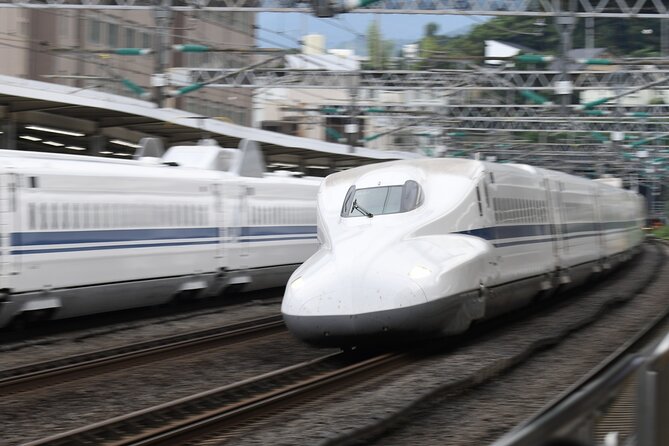
The train is one of the strongest parts of the experience. Instead of flying, you travel between central city stations and avoid airport transfers. Bullet trains are also a good way to see the distance between Tokyo and Kyoto in a single, comfortable stretch.
The tickets between Tokyo and Kyoto are included. Public transportation in both cities is included as well, which covers an important part of the day’s cost and planning.
Once you arrive at Kyoto Station, you will use local transportation toward Kinkaku-ji. The schedule says bus travel is part of this section. Buses can be slower than a private car, especially when roads are busy, but they put you into the city rather than dropping you at an isolated tourist stop.
You should treat the train ride as useful travel time, not dead time. It is the longest uninterrupted part of the day, and the guide can explain what lies ahead. The return train gives you a chance to rest after the Kyoto portion, though the overall day may leave you ready for an early night.
Kinkaku-ji and the Golden Pavilion
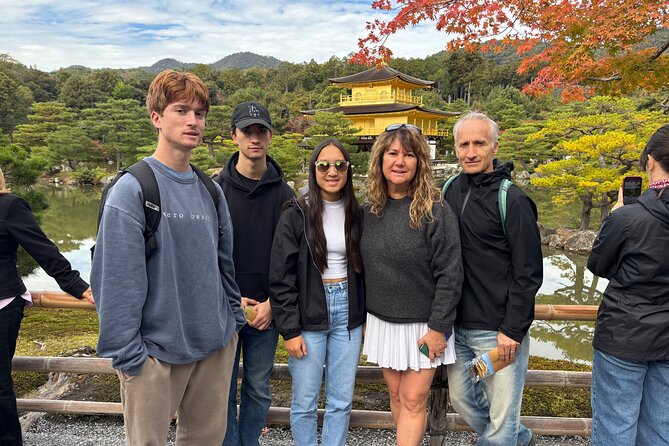
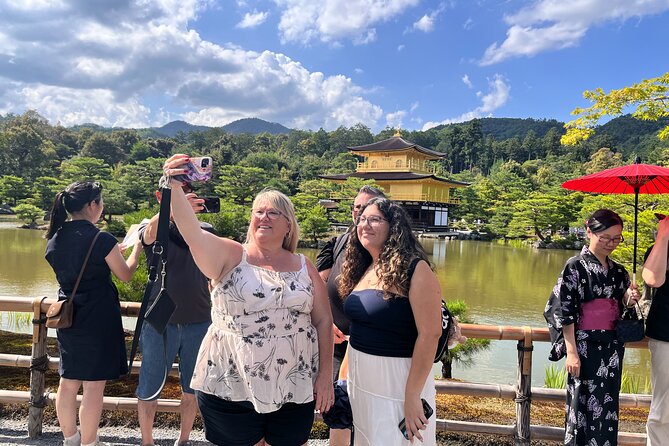
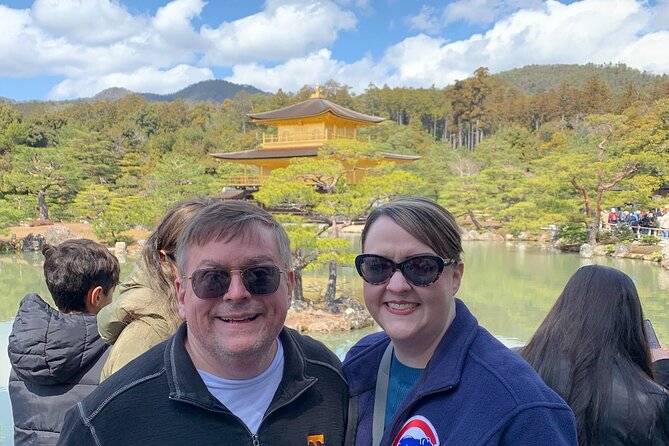
Kinkaku-ji, commonly called the Golden Pavilion, is the visual centerpiece of the morning. The Zen Buddhist temple is famous for its gold-covered pavilion set beside reflective water, with gardens and wooded surroundings adding to the scene.
Admission is included. You will have about one hour at the temple, which is enough to see the main view, walk through the grounds, and hear context from your guide. It is not enough for a slow examination of every corner, so keep your pace steady.
What makes Kinkaku-ji useful on a first Kyoto visit is its immediate impact. You do not need a long explanation to understand why it matters. The building, pond, and garden composition create a clear image of classical Kyoto in a short amount of time.
The limitation is crowding and time. The pavilion is one of Kyoto’s best-known sights, so you should not expect a quiet private encounter. Your guide can help you understand what you are seeing, but no guide can turn a famous temple into an empty one.
The supplied material spells the name once as Kinakuji, but Kinkaku-ji is the standard spelling you are most likely to see on signs and maps. Keep that in mind when checking directions.
Nishiki Market, Kyoto’s food corridor
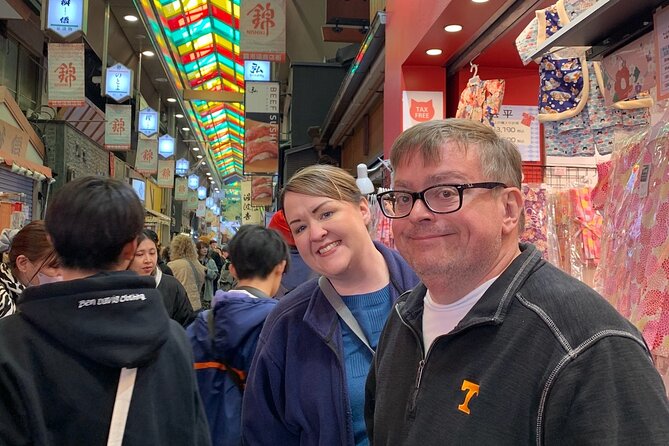
Nishiki Market gives the day a welcome change of pace. After the temple’s formal setting, you move into a covered shopping street in central Kyoto known as Kyoto’s Kitchen. The market stretches for about five blocks and sells a wide range of food and local goods.
You have about one hour here. That is enough to browse, sample something if you choose, and ask your guide about ingredients or customs. It is not enough to inspect every stall, eat a full meal, and shop at leisure.
Lunch costs about $15 to $20 per person and is not included. You can ask about dietary needs when booking, since vegetarian, vegan, and gluten-free requirements can be accommodated. This matters at a food market, where ingredients and preparation may not always be obvious to someone unfamiliar with Japanese dishes.
Nishiki Market is also a practical stop for mixed groups. Children may find the food displays more engaging than a long temple lecture, while adults can look for snacks and small gifts. Your guide can help you make sensible choices, but personal purchases remain your responsibility.
Do not expect a sit-down restaurant experience to fit easily into the hour. If lunch is important to you, tell the guide at the start of the day. The market is best treated as a focused food and shopping stop rather than a leisurely afternoon.
Our other Sapporo reviews may also help you decide


Fushimi Inari’s red torii gates
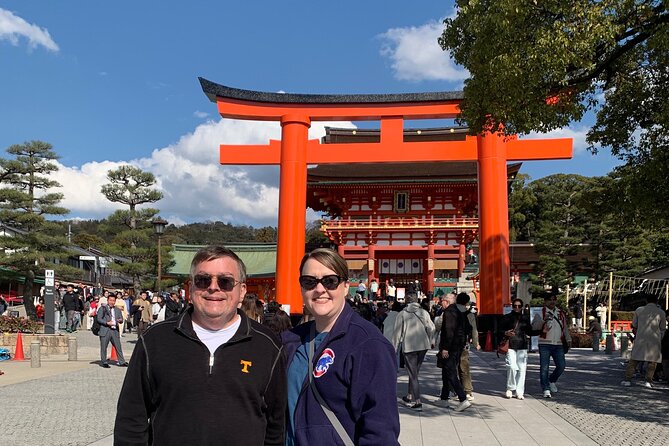
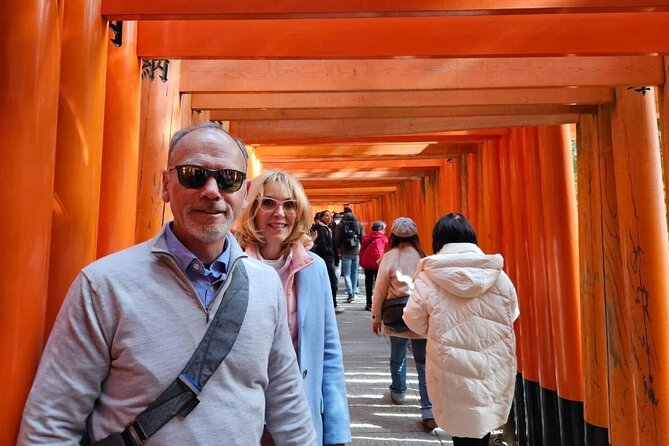
Fushimi Inari-taisha is the most active walking stop, with about two hours set aside. The shrine is famous for its thousands of red torii gates, which form paths up wooded Mount Inari.
You do not need to climb the entire mountain to understand the appeal. The lower paths provide the iconic gates and the strongest first impression. If you want to walk farther, your guide can help judge how much time remains before the return to Kyoto Station.
This stop also offers a different side of Kyoto. Kinkaku-ji is a compact temple visit with a famous architectural view. Fushimi Inari feels more like a path through a living religious site, with gates marking the route upward and the forest changing the mood as you walk.
The tradeoff is physical effort. The ground rises, and two hours can pass quickly if you stop often for photographs. Wear proper walking shoes and tell your guide if anyone in your group needs a gentler pace.
Because the site is popular, the lower section may be crowded. Walking farther can change the feel, but you should not assume that the entire route will be quiet. The tour gives you enough time for a good visit, not an all-day mountain walk.
Returning through Kyoto Station
After Fushimi Inari, you return to Kyoto Station for the bullet train to Tokyo. The schedule allows about three hours for this final transportation segment, including getting back to the station, boarding, and reaching Tokyo.
This is another point where a private guide has real value. Missing a train would damage the whole plan, especially when your hotel and return arrangements are in Tokyo. Yutaka’s role, as described in the supplied details, included guiding a group safely through the network and helping with the return journey.
The tour ends at Tokyo Station, with about 30 minutes listed at the red-brick station building and its mailbox landmark. This is a small finish, not a separate sightseeing tour. It gives you a clear endpoint near the Marunouchi area.
Taxi costs are not included. If a taxi is needed, the supplied estimate ranges from $10 to $200 depending on distance. That is a very wide range, so ask ahead if your hotel lies far from the station or if your group has mobility concerns.
What the $915 price really buys
At $915 per person, this is an expensive day trip. You are paying for more than transportation, but you should decide if those extras matter to you.
The price includes:
- Bullet train tickets between Tokyo and Kyoto
- Public transportation in Tokyo and Kyoto
- Hotel pickup
- A nationally licensed guide
- Admission fee
- Private participation for your group
The guide is the main value. If you are comfortable using Japanese trains, buses, and station signs, you could reduce the cost by arranging much of the day yourself. You would then need to coordinate the timetable, local transportation, temple admission, and return connection without the same level of help.
The price becomes easier to justify for families, older adults who want a smoother route, or small groups that would otherwise divide the cost of a private guide and transport service. It also makes sense if Kyoto is unlikely to fit elsewhere in your Japan plans.
It is a weaker value if you already have several nights in Kyoto. In that case, you can spread these sights across multiple days and avoid paying for a rushed round trip from Tokyo. The $915 price does not include lunch, personal purchases, or any taxi that becomes necessary.
Who should choose this day trip
I would consider this tour for a first-time Japan visit built around a Tokyo hotel, especially if Kyoto is a must-see but your schedule has no room for an overnight stay.
It suits families because one guide can adjust the pace and explain the transport steps. It can also work for a private group with different interests, since the plan may be customized. English, Spanish, and French guiding is offered.
Adventure seekers should understand that this is an organized way to reach Kyoto, not an independent rail challenge. The adventure comes from covering a great distance and seeing three major places in one day.
I would hesitate to recommend it to anyone who dislikes early starts, long train rides, or fixed time limits. I would also think twice if you want to hike deeply into Fushimi Inari or spend hours eating and shopping at Nishiki Market.
The tour requires moderate physical fitness. Service animals are allowed, and the route is near public transportation, but the supplied information does not promise that every part of the route is fully accessible. Ask specific questions before booking if mobility is a concern.
Booking details worth checking
Confirmation is normally sent at booking. If you book within seven days of departure, confirmation may arrive within 48 hours and depends on availability.
Free cancellation is available up to 24 hours before the experience start time for a full refund. Cancellations or changes made inside that 24-hour window are not accepted for a refund, with cut-off times based on local time.
One detail deserves special attention: the location field says Sapporo, while every transport detail concerns pickup in Tokyo and travel to Kyoto. Since the route begins at a Tokyo hotel and Tokyo Station, confirm the operating location, hotel coverage, and exact meeting instructions directly with MY Travel Consulting.
Should you book this Kyoto day trip?
Book it if Kyoto is a priority, you are staying in Tokyo, and you place a high value on a private guide handling the train stations and local transport. Kishy and Yutaka show the kind of practical station support that can make this ambitious day feel manageable.
Do not book it simply because it is the fastest way to check Kyoto off a list. You will spend much of the day traveling, and the $915 price is high for a schedule that allows only about one hour at Kinkaku-ji, one hour at Nishiki Market, and two hours at Fushimi Inari.
My call: this is a strong convenience choice for a private group with limited time, but a poor substitute for staying in Kyoto. Confirm the Tokyo location, ask about your preferred sights, and decide if guided transport is worth the premium before you commit.
FAQ
Where does the tour begin?
The tour offers pickup from your hotel in Tokyo and then travels to Tokyo Station. The listed station meeting point is Tokyo Station Marunouchi Ekimae Hiroba.
How long is the experience?
The experience lasts approximately 12 hours.
How long is the bullet train ride?
The ride from Tokyo to Kyoto takes about two and a half hours. The return trip also takes about two and a half hours.
What sights are included in Kyoto?
The planned stops are Kinkaku-ji Temple, Nishiki Market, and Fushimi Inari-taisha Shrine.
Is the tour private?
Yes. Only your group participates.
Which guide languages are available?
Nationally licensed guides are available in English, Spanish, and French.
Are bullet train tickets included?
Yes. Bullet train tickets between Tokyo and Kyoto are included.
Is lunch included?
No. Lunch costs about $15 to $20 per person and is not included.
Can dietary requirements be accommodated?
Yes. Vegetarian, vegan, gluten-free, and other dietary restrictions can be accommodated if you provide the details when booking.
Can the itinerary be changed?
Yes. The plan can be customized if you want to visit other specific places, although weather or other reasons may also cause changes.
What happens if I need a taxi?
Taxi fees are not included. The supplied estimate is $10 to $200, depending on the distance.
What is the cancellation policy?
You can cancel up to 24 hours before the experience start time for a full refund. Cancellations or changes made less than 24 hours before the start are not accepted for a refund.