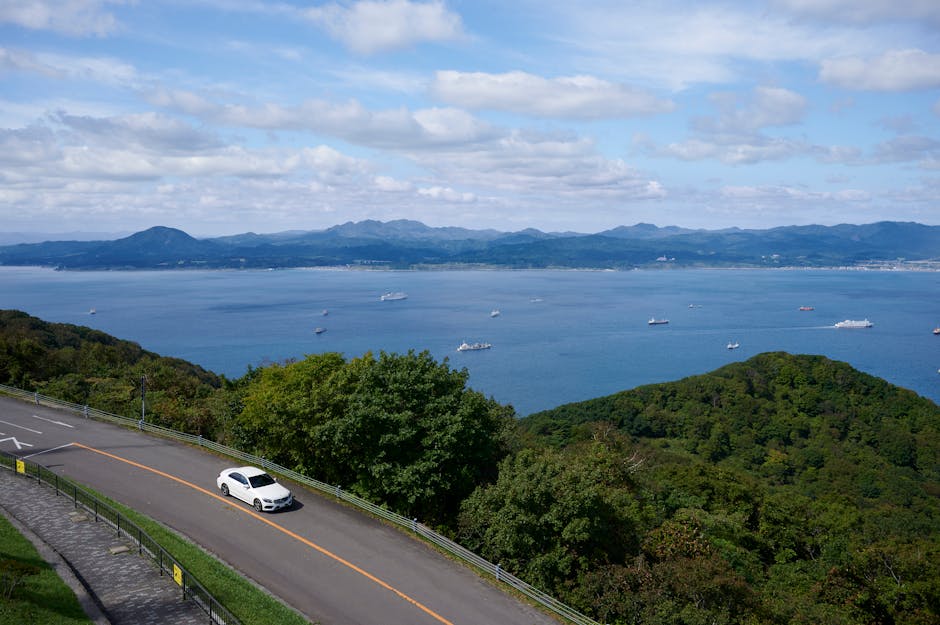
Driving is the best way to see Hokkaido. The island is large — roughly the size of Austria or Ireland — and public transport thins dramatically outside the main cities. The most scenic landscapes are along roads that no train or bus follows, and the most rewarding detours are the ones you make on impulse when something catches your eye. Rental cars are affordable (from ¥5,000/day/~$34), roads are well-maintained, and traffic outside Sapporo is so light that you will sometimes drive 20 minutes without seeing another car.
The driving itself is part of the experience. Long straight roads through agricultural plains, mountain passes with volcanic views, coastal routes along rocky headlands, and forest roads under canopy — Hokkaido has driving variety that the rest of Japan, with its dense development and congestion, simply doesn’t offer.
Best Driving Routes
Sapporo → Otaru → Yoichi → Niseko (Half Day)
The most popular driving route for visitors and a natural introduction to Hokkaido’s coastal scenery. Follow the expressway or the coastal Route 5 from Sapporo to Otaru (40 minutes), where you can stop for canal-side sushi and a walk through the glass shops. Continue along the scenic coast through Yoichi — stop at the Nikka Whisky Distillery for a free tour and tasting — then climb over the Nakayama Pass into the Niseko valley. Total driving time without stops: about 2.5 hours. With stops, budget a full day.
The Nakayama Pass (Route 230/393) is the main connecting road and offers views of Mt. Yotei on clear days. In winter, this pass can be treacherous — steep, winding, and icy. The expressway via Kutchan is a safer alternative in heavy snow, though less scenic.
Biei Panorama Road + Patchwork Road (Full Day)
The most photogenic drive in Hokkaido, and arguably in Japan. Two connected driving routes through Biei’s rolling agricultural hills create a loop that can be driven in 2-3 hours but deserves a full day with stops. Patchwork Road covers the western hills — crop fields in alternating colours creating a natural quilt pattern against the mountain backdrop. Panorama Road runs east with wider views toward the Tokachi mountains. Famous stops include the Blue Pond, Shirogane Falls, Shikisai no Oka flower park, and a series of individually named trees (the Christmas Tree, Ken and Mary’s Tree) that have become unlikely landmarks.
Best from June through October. In July, the lavender fields at Farm Tomita add another dimension. The roads are quiet, well-paved, and the terrain is gently rolling — pleasant driving rather than challenging. Roadside corn stands and melon sellers appear in summer.
Eastern Hokkaido Circuit (3–5 Days)
The grand tour, and the drive that people remember years later. A loop from Sapporo through Obihiro, Kushiro, the Akan lake district, Abashiri, and Shiretoko before returning via Asahikawa or flying out from Memanbetsu Airport.
Day 1: Sapporo to Obihiro (3 hours via expressway). Butadon lunch, Tokachigawa Onsen evening. See Tokachi guide.
Day 2: Obihiro to Kushiro (2 hours). Kushiro Wetlands for cranes (winter) or canoe tour (summer). Washo Market for DIY seafood donburi. Stay in Kushiro or drive to Akanko Onsen (1.5 hours).
Day 3: Akan lake district. Lake Akan (marimo boat tour, Ainu Kotan), Lake Mashu (crater viewpoint), Lake Kussharo (free lakeside onsen at Kotan). Drive to Utoro on the Shiretoko coast (2.5 hours).
Day 4: Shiretoko. Five Lakes walk in the morning, sightseeing boat if weather allows. Drive to Abashiri (1.5 hours). Prison Museum, drift ice in winter.
Day 5: Abashiri to Asahikawa (3.5 hours via Kitami Pass) or fly from Memanbetsu Airport.
This route covers Hokkaido at its wildest — volcanic crater lakes, UNESCO wilderness, drift ice, red-crowned cranes, and landscapes that feel more like Kamchatka than Japan. See our eastern Hokkaido guide for detailed coverage.
Southern Onsen Loop (2–3 Days)
A compact loop through Hokkaido’s volcanic south: Sapporo to Lake Shikotsu (50 minutes), then to Noboribetsu (1 hour), Lake Toya (40 minutes), and back to Sapporo (2 hours). Volcanoes, crater lakes, hell valleys, and some of the best onsen bathing in Hokkaido. Each stop has distinctive hot spring water — the acidic sulphur baths at Noboribetsu are nothing like the sodium chloride waters at Toyako.
This route works year-round and is the best option for visitors with only 2-3 days beyond Sapporo. The roads are well-maintained even in winter, and the distances are manageable. Adding a detour to Hakodate extends it to 4-5 days. See our onsen guide.
Northern Coast (2–3 Days)
Asahikawa to Wakkanai via the Sea of Japan coast, with a ferry crossing to Rishiri and Rebun islands. The drive north passes through Rumoi and Mashike (sake brewery country), the Sarobetsu Wetland, and increasingly empty landscapes of grassland and dairy farms. Cape Soya — Japan’s northernmost point — is 30 minutes east of Wakkanai.
Best in summer (June through September) when the island ferries run full schedules and the wildflowers on Rebun are in bloom. The remoteness is the appeal — this is rural Japan at its most untouched, with very few tourists and a pace that forces you to slow down. The Rishiri sea urchin, eaten fresh on the island, is some of the finest in Japan.
Shakotan Peninsula (Day Trip)
A day trip from Sapporo or Otaru along the dramatic Shakotan Peninsula, about 2 hours west. Cape Kamui and Cape Shakotan have some of the most striking coastal scenery in Hokkaido — turquoise water, sheer cliffs, and sea caves. The Shakotan Blue (the distinctive colour of the water) is famous throughout Japan. Less visited than most Hokkaido destinations, partly because there is no public transport to the capes. Good hiking trails along the headlands. Uni (sea urchin) is excellent here in summer.
Car Rental Essentials
Cost: Compact cars from ¥5,000-8,000/day (~$34-54). Longer rentals are proportionally cheaper — a week might run ¥25,000-35,000 (~$170-240). K-cars (660cc) are cheapest but feel underpowered on expressways. A standard compact (Fit, Note, Yaris) is the sweet spot.
Pickup: New Chitose Airport has all major companies (Toyota Rent-a-Car, Nippon Rent-a-Car, Times, Orix, Budget). The process takes about 30 minutes. Sapporo Station area also has many offices. Book online in advance — peak season (February Snow Festival, July-August, year-end) can sell out.
International licence: You need an International Driving Permit (IDP) issued in your home country before arrival. Japanese car rental companies will not accept a foreign licence alone. Some countries (Switzerland, Germany, others) have bilateral agreements that work differently — check before you go.
Winter tyres: Mandatory November through April. All rental cars in Hokkaido come equipped with studless winter tyres automatically — you don’t need to request them.
Insurance: Basic liability insurance is included. Collision damage waiver (CDW) is optional but recommended at ¥1,000-2,000/day (~$7-14). Without it, you are liable for any damage to the vehicle. A non-operation charge (NOC) of ¥20,000-50,000 applies even with CDW if the car needs repairs — some credit cards cover this.
Navigation: Most rental cars include GPS navigation in Japanese (and often English). Google Maps on your phone is the most reliable backup. Download offline maps for eastern Hokkaido where signal can drop. See our detailed car rental guide.
Compare prices at RentalCars.com or ToCoo! (Japan specialist, often has Hokkaido Expressway Pass bundles).
Driving Tips
- Speed limits: 60 km/h on regular roads, 80-100 km/h on expressways. Speed cameras are common. Drive at the posted limit.
- Expressway tolls: Can add up quickly. The Hokkaido Expressway Pass (HEP) offers flat-rate unlimited use for foreign visitors and often saves money on longer trips. Available through ToCoo! and some rental companies.
- Gas stations: Plentiful near cities but sparse in eastern and northern Hokkaido. Fill up when you see a station if your tank is below half — the next one might be 50+ km away.
- Wildlife: Deer cross roads frequently, especially at dawn and dusk in rural areas. Eastern Hokkaido has the highest density. Hit a deer at 80 km/h and the damage is severe. Slow down in forested areas after dark.
- Rest stops (Michi no Eki): Hokkaido has an excellent network of roadside rest stops with toilets, local food stalls, souvenir shops, and tourist information. They are marked on all GPS units and are genuinely worth stopping at — the food at some Michi no Eki rivals proper restaurants. Tokachi area and coastal stations tend to have the best local produce.
- Winter driving: Hokkaido drivers are experienced in snow, and the roads are cleared quickly after storms. But black ice, whiteout conditions, and drifting snow are real hazards. If you are not experienced driving in snow, stick to expressways and main routes. Carry extra warm clothing, a charged phone, and water in the car. If conditions deteriorate, stop at a Michi no Eki and wait it out.
When to Drive
Summer (June–September): The easiest and most rewarding driving season. Long daylight hours, dry roads, and all routes open. July and August have the best weather but also the most traffic (still light by mainland standards).
Autumn (October–November): Excellent driving season. Autumn colour, clear skies, and diminishing crowds. Mountain passes start getting frost in late October — check conditions for high-altitude routes.
Winter (December–March): Driving is possible and common — locals drive year-round — but conditions require experience and caution. Some mountain passes close (Shiretoko Pass, some Daisetsuzan routes). Main highways and expressways are well-maintained.
Spring (April–May): Snow is melting, some mountain roads reopen (Shiretoko Pass typically late April). Conditions can be mixed — sunny valleys and snowy passes on the same day.